A long article on the reasons for engaging with Antarctica (in Estonian)
A rather long feature on climate change and geopolitics of Antarctica, and what the Estonian role could be on that continent.
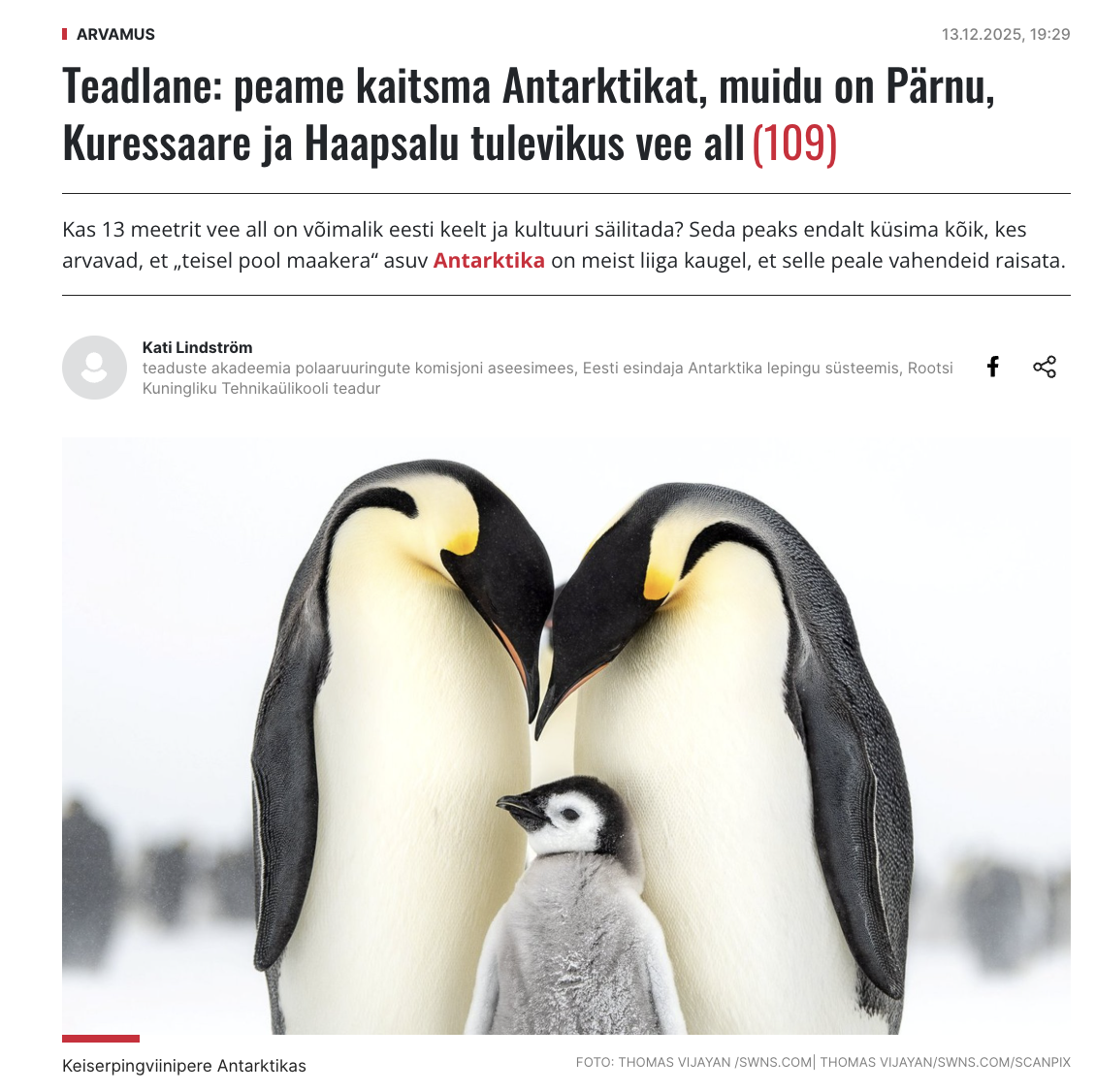
A rather long feature on climate change and geopolitics of Antarctica, and what the Estonian role could be on that continent.
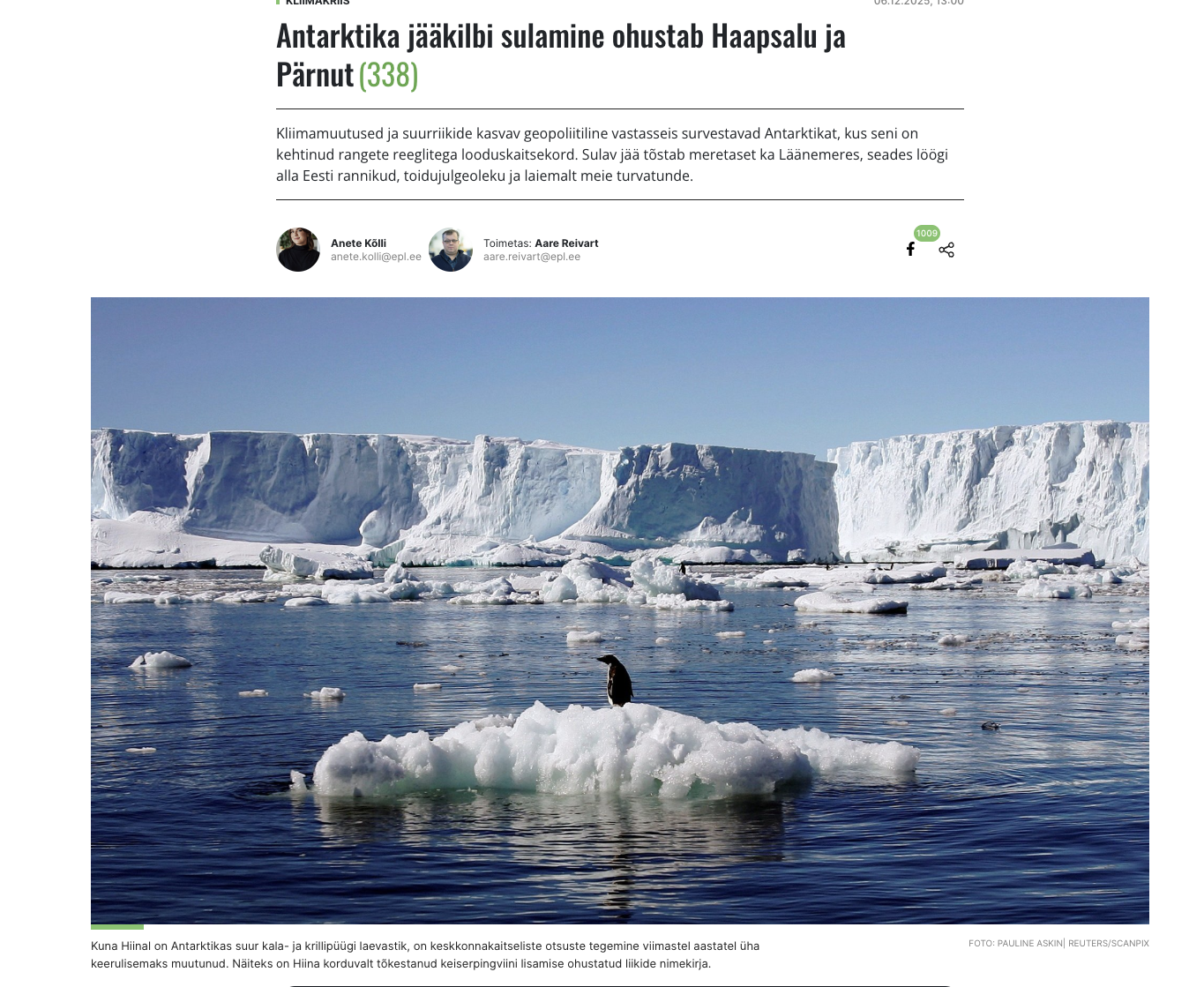
After the meetings and sessions of Antarctica Day were finished, I also gave an interview to the green news portal of one of the bigger media consortia. The title is pretty scandalous - and I guess it worked, guessing from the number of reactions. I do not read the comments myself, as they are often dominated by troll factories. But I am grateful that so many people took their time to read - and I hope something stuck.
December 1st is celebrated as Antarctica Day around the world because that is the day when the Antarctic Treaty was signed in 1959, dedicating Antarctica to peace and science. It is also the day when the Estonian Polar Club was established in 1984 - these kinds of clubs were an extreme rarity at that time, but somehow managed to get permission to operate under the Estonian Maritime Museum. It is also the day when in 2017 Ross Sea Marine Protected Area entered into force (signed in 2016) - this is the last time CCAMLR was capable of passing a decision on an MPA. Three other proposed MPAs have not been able to gain a consensus vote despite very solid scientific grounds due to some Parties’ dedicated obstruction of protection measures.

Birgit Njåstad speaking to the audience in the beautiful hall of the Estonian Academy of Sciences. Click on the picture to access the video recording of the day. Photo: Rene Riisalu
To celebrate the core values of peace, science and environmental protection that the Antarctic Treaty upholds, look back at Estonia’s scientific engagement and discuss what this should look like in future, and analyse the complicated geopolitical situation of polar politics, we have organised a half-day symposium in the Estonian Academy of Sciences. Dreamed up during the Milan ATCM, the Symposium united all major stakeholders of Estonian polar affairs. It was organised in collaboration between the Polar Research Committee of the Estonian Academy of Sciences, Estonian Ministry of Foreign Affairs, Estonian Ministry of Climate, and Estonian Polar Club. It was a pleasure to welcome the former CEP-chair and a true expert on Antarctic environmental protection, Brigit Njåstad from the Norwegian Polar Institute, to Tallinn for a keynote speech. Equally valuable was the participation of all our international and local panelists. (Click on the picture above to access the recording of the day!)
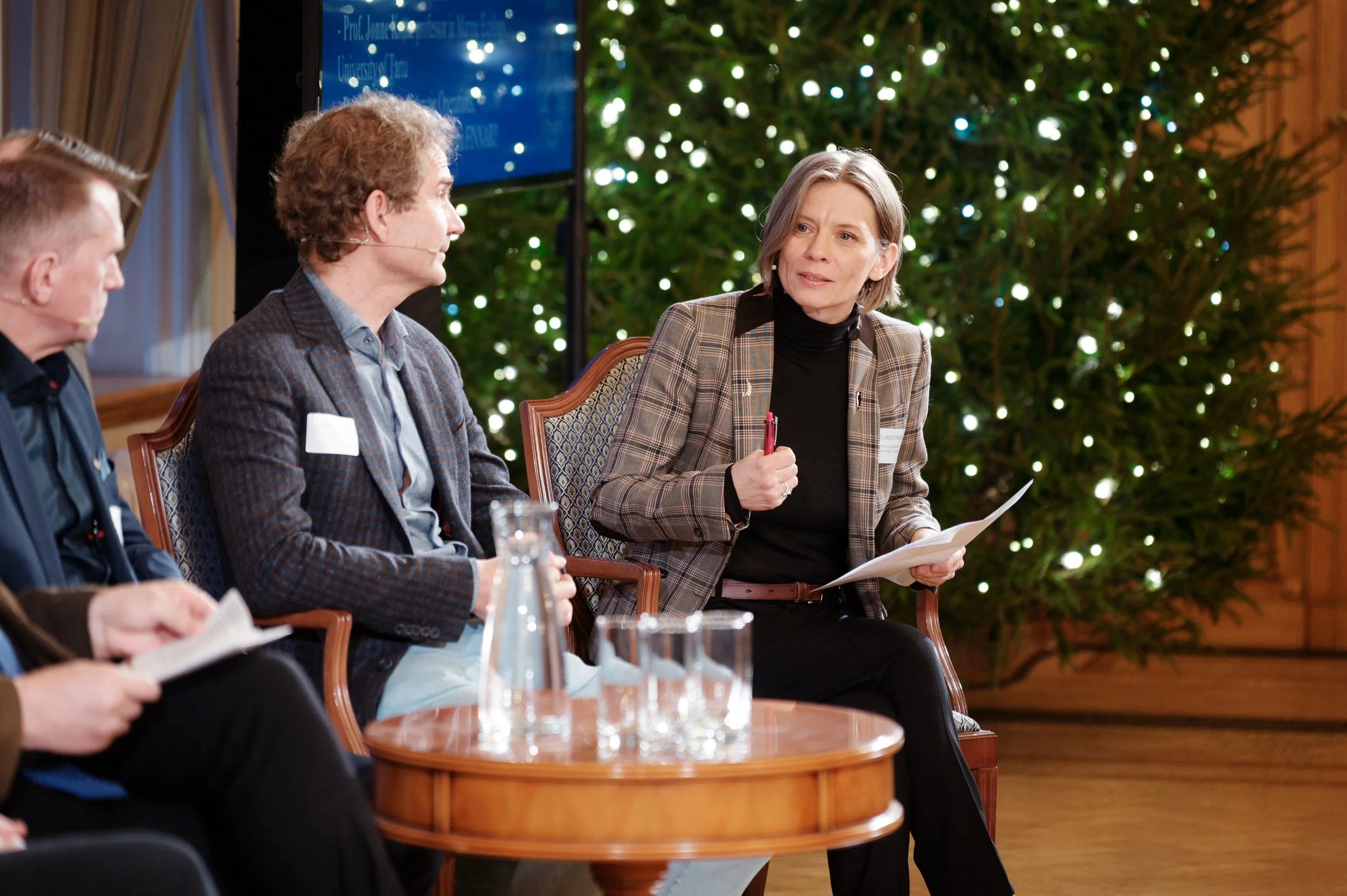
Leading the panel discussion. Photo: Rene Riisalu
For myself, this meant chairing a panel on Antarctic Environmental Protection, Climate Change and Europe, several media engagements (including appearance in the morning program of Kanal 2, see 59:30 ff) and supporting the social media campaign of the institutions with expert advice. While we obviously cannot solve the geopolitical deadlock of the Antarctic Treaty System, we could hopefully contribute to increased awareness of the Antarctic politics, particularly the Madrid Protocol, and the needs of Antarctic science in Estonia.
I am humbled and excited to be appointed as the ICOMOS International Polar Heritage Committee’s Antarctic Treaty System Liaison Officer.
International Polar Heritage Committee is an international scientific committee working with polar heritage within the International Council of Monuments and Sites (ICOMOS) and I have been serving in this committee as an expert member since 2019. In my capacity as a Liaison Officer to the Antarctic Treaty System, I will work with advocating on Antarctic heritage matters within the Antarctic Treaty System and facilitating the communication between the Treaty and the IPHC.
Currently, several important heritage issues are under scrutiny within the Antarctic Treaty, such as the impact of climate change or tourism to the heritage sites. I hope to contribute with not only the knowledge of individual heritage sites and today’s Antarctic Treaty politics, but also with my knowledge of the historical development of Antarctic Treaty heritage instruments.

Photo: Georg Savisaar (Estonian Public Broadcasting)
2023 is soon drawing to close and it is time to look back to the year of Antarctic activities as well. It is probably right to say that the less is published on the blog, the more is going on, as all the energy goes to the world outside the www.
In May and early June this year, I had the honour to participate in the Estonian delegation to the Antarctic Treaty Consultative Meeting (ATCM) held in Helsinki. From the same month I serve also as the Estonian contact point to the Antarctic Treaty.

Antarctic Treaty meetings are prime scientific diplomacy, so researchers have also been present at its diplomatic meetings, but it was a pleasure to see Estonia re-emerge at the ATCMs and signal that we are still committed to and interested in rules-based international order and environmental protection of the Antarctic environment. One of the important messages that Helsinki ATCM tried to signal was the urgency of climate change in Antarctica and the fact that what happens in Antarctica impacts the entire world, and it felt good to see that much of the research that we have been doing is relevant this global diplomatic system. Also, after all these years of going through tens and thousands of documents from and about the ATCMs in all imaginable archives around the globe, it felt really nice to see this system in action.

Climate Change and Cultural Heritage in Antarctica, XXV Science Afternoon of the U.S. Embassy in Estonia and the Estonian Academy of Sciences "Polar Research in Estonia" held on September 20, 2023
Estonia is a non-consultative member of the Antarctic Treaty, but has not ratified the Environmental Protocol yet. To draw attention to the polar research in Estonia and remind the decision-makers of the necessity to join the Environmental Protocol in order to be able to partake in the decision-making in Antarctica, the Estonian Academy of Sciences and the Embassy of United States of America in Estonia organised XXV Science Afternoon,"Polar Research in Estonia" on September 20, 2023.
You should be able to come to my talk by clicking on the picture. Polar science is by its nature big science, requiring big infrastructure and big money - things that Estonia does not have much of. Transition from being a part of Soviet Union’s Antarctic program with bottomless resources and from the optimistic economic growth of the early 2000s has not been painless. In short-term project-based international science where most of Estonian scientists need to work with time-limited grants in other countries’ programs to be able to do Antarctic science, it is hard to foster the next generation of Antarctic scientists and to even say where Estonian Antarctic science ends and others’ starts. None of my work would have been possible without the scholars in Argentina and Sweden whom I work with. However, conscious efforts in fostering a new generation is something that the Polar Research Committee of the Estonian Academy of Sciences will need to work with in the coming years.
Presenting the role of environmental NGOs in Antarctic mineral negotiations at the SCAR Standing Committee on Antarctic Humanities and Social Sciences (SC-HASS) conference in Lisbon as well as the European Society of Environmental History biannual conference in Bern almost feel like non-events in this line but were very giving. Another talk that gave me a lot of joy was a presentation in Swedish at the S A Andrées Polardagar at Grenna Museum and Polar Centre. It is not that often I get to speak to the Swedish audience outside the university and it feels good to give back to the people whose taxes have financed my research for many years. On the request of the tireless Håkan Joriksson who runs the museum and the polar days, I spoke on the past, present and future of the Antarctic Treaty to a very passionate crowd of Antarctic aficionados.